
Meteorites are rocks from space that land here on Earth and can be used to study the origins of the Solar System. Most meteorites are from asteroids that are 4.6 billion years old, while others come from the Moon and Mars.
Meteorites start life as rocky fragments ejected from bodies in the Solar System (meteoroid) that end-up on Earth-crossing orbits. On entering Earth’s atmosphere, they produce a bright streak in the sky known as a fireball (meteor). For the largest rocks these events are often dramatic, with high altitude breakup, several flashes of bright light, and shock waves.
Any rocks that survive and land on Earth are called meteorites. These fragments, which can vary from a few cm to a couple of meters in size, usually have a distinctive dark (the colour depends on the type of meteorite, but it is typically black and somewhat shiny) fusion crust that forms during super heating and ablation in the atmosphere.

Meteors, Fireballs & Meteorites
To date, over 70,000 meteorites have been found world-wide. However, less than 0.1% of recovered meteorites were imaged as they travelled through Earth’s atmosphere as fireballs.
Meteor camera networks are designed to record meteors and fireballs, with observations from multiple locations on the ground allowing the meteor’s brightness, velocity, and path through the atmosphere to be calculated accurately. From this, we can:-
- calculate the incoming object’s orbit around the Sun before it arrived on Earth.
- estimate the size, strength, density, and composition of the object.
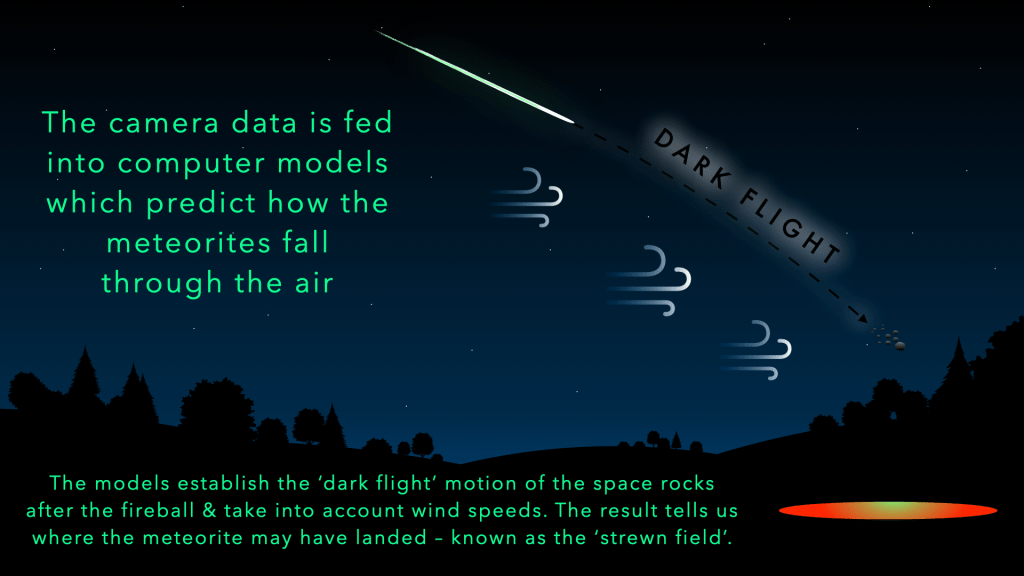
- determine if any meteorites are likely to have made it to the surface, and if so, where they may have landed (strewn field).
This information allows us to study the abundance, physical properties, and sources of extraterrestrial dust and rocks being delivered to Earth from bodies in the Solar System. In some cases, it is possible to directly link meteorites to their parent bodies, while accurate strewn fields enable the rapid recovery of pristine samples uncontaminated by the terrestrial environment.

How does UKFAll work?


You can read more about meteorite science and how we study meteorites at some of our partner websites:
 The UK Fireball Alliance